


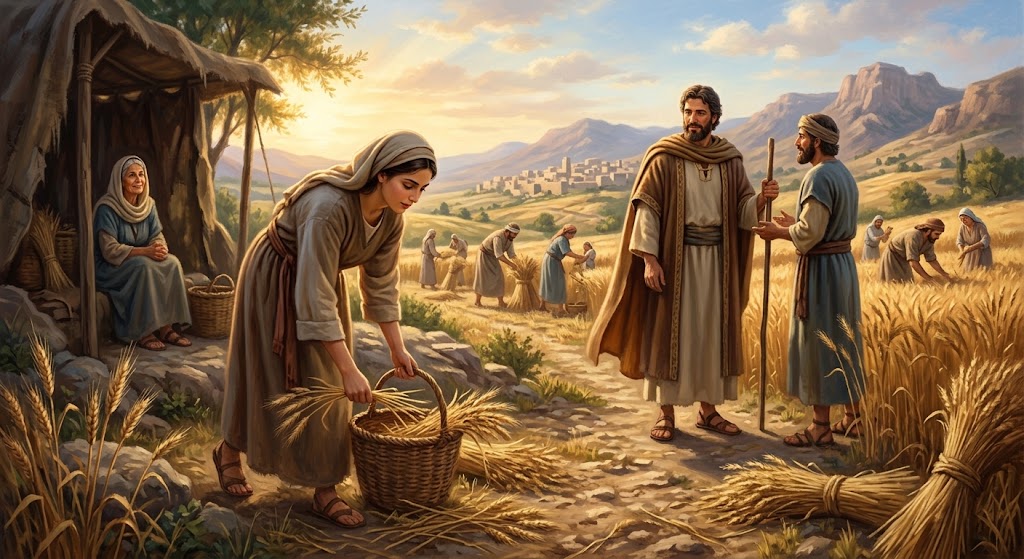
Ruth Study: Faith, Diligence, and Godly Leadership
Ruth 1:16–17 – Unwavering Loyalty, Covenant Commitment, and Determination
Scripture (NKJV):
“But Ruth said: ‘Entreat me not to leave you, or to turn back from following after you; for wherever you go, I will go; and wherever you lodge, I will lodge; your people shall be my people, and your God, my God. Where you die, I will die, and there will I be buried. The Lord do so to me, and more also, if anything but death parts you and me.'”
In-Depth Historical & Spiritual Context
- Leaving Everything Behind: Ruth was a Moabite widow in a patriarchal ancient Near Eastern world. By choosing to stay with Naomi, she deliberately walked away from her homeland, her biological family, cultural comforts, and the Moabite gods (Chemosh).
- Embracing Poverty and Vulnerability: She possessed zero social guarantees in Judah. Widows without sons were among the most vulnerable, impoverished members of society. Humanly speaking, returning to her mother’s house in Moab (as Orpah did) was the only rational path toward securing a second husband and economic security.
- Covenantal Devotion (Chesed): Ruth’s statement is not merely sentimental affection; it is a sacred covenant vow. She invokes Israel’s covenant name for God (Yahweh—”The Lord do so to me, and more also”), binding herself not only to Naomi, but irrevocably to the God of Israel. Her loyalty reflects God’s own steadfast, covenant love (chesed).
Core Learnings & Application
- Conviction Beyond Circumstance: When you commit to a righteous path, stay anchored even when circumstances turn bleak, uncomfortable, or unpredictable. Faithfulness is proven when loyalty costs something.
- Re-evaluating Through God’s Moral Compass: While human philosophy suggests you can discard past commitments at whim, biblical fidelity urges you to calibrate your heart against God’s eternal values. When major life decisions arise, let covenant integrity—not mere fleeting emotion or convenience—direct your steps.
Ruth 2:1–2 – Diligence: Working Faithfully with Your Hands
Scripture (NKJV):
“There was a relative of Naomi’s husband, a man of great wealth, of the family of Elimelech. His name was Boaz. So Ruth the Moabitess said to Naomi, ‘Please let me go to the field, and glean heads of grain after him in whose sight I may find favor.'”
In-Depth Historical & Spiritual Context
- Faith Expressed Through Action: Ruth did not sit in Naomi’s house waiting passively for divine provision or charity to drop from the sky. Despite grieving the loss of her husband and enduring the stigma of being a destitute foreigner in Bethlehem, she took the initiative to work.
- The Law of Gleaning: Under Mosaic law (Leviticus 19:9–10; Deuteronomy 24:19), landowners were forbidden from harvesting the extreme edges of their fields or picking up fallen stalks, leaving them for the poor, the stranger, the fatherless, and the widow. Ruth was willing to perform the backbreaking, humble labor of gathering leftover barley under the hot sun to feed her mother-in-law.
- Providence Meets Diligence: Notice the sequence: Ruth set out to work first, and in doing so, God providentially guided her steps directly into the field of Boaz (Ruth 2:3). God’s supernatural guidance frequently intersects with our practical obedience and honest labor.
Core Learnings & Application
- Work with What Is in Your Hand: Regardless of your current station or the scale of your resources, honor God through diligent, practical effort. As Proverbs 10:4 reminds us: “He who has a slack hand becomes poor, but the hand of the diligent makes rich.”
- Humility Over Pride: God honors those who are not above doing basic, honest work. Do not wait for ideal conditions before you begin; step out in diligence, and trust God to direct your labor toward His divine purpose.
Ruth 2:4–16 – Righteous Leadership: Using Authority to Protect and Empower
Scripture (NKJV):
(Ruth 2:4–9 excerpted below; full passage spans verses 4–16)
“Now behold, Boaz came from Bethlehem, and said to the reapers, ‘The Lord be with you!’ And they answered him, ‘The Lord bless you!’
Then Boaz said to his servant who was in charge of the reapers, ‘Whose young woman is this?’
So the servant who was in charge of the reapers answered and said, ‘It is the young Moabite woman who came back with Naomi from the country of Moab. And she said, “Please let me glean and gather after the reapers among the sheaves.” So she came and has continued from morning until now, though she rested a little in the house.’
Then Boaz said to Ruth, ‘You will listen, my daughter, will you not? Do not go to glean in another field, nor go from here, but stay close by my young women. Let your eyes be on the field which they reap, and go after them. Have I not commanded the young men not to touch you? And when you are thirsty, go to the vessels and drink what the young men have drawn.'”
In-Depth Historical & Spiritual Context
- A Culture of Godly Workplace Leadership: The very first words recorded from Boaz to his laborers are a blessing: “The Lord be with you!” He did not rule by intimidation, exploitation, or aloof superiority. The reapers responded with equal warmth and respect (“The Lord bless you!”), proving that Boaz cultivated a workplace culture founded on mutual honor and reverence for God.
- Observant Stewardship: Boaz immediately noticed the newcomer and inquired about her situation. A godly leader pays attention to the weak and marginalized under his sphere of influence rather than ignoring them.
- Protector of the Vulnerable: In the ancient world, foreign women gleaning alone in the fields were at severe risk of sexual harassment, assault, and abuse. Boaz explicitly commanded his young men not to touch or mistreat her (v. 9), placed her among his own female workers for safety, and invited her to drink from the water vessels drawn by the male servants—an extraordinary courtesy toward an impoverished foreigner.
- Generosity with Dignity (v. 14–16): At mealtime, Boaz invited Ruth to eat roasted grain alongside his household until she was satisfied. He then privately instructed his reapers to purposefully pull stalks from the bundles and drop them for her to gather without rebuking or embarrassing her. He blessed her abundantly while preserving her dignity as a diligent worker.
Core Learnings & Application
- Never Abuse Power or Position: True authority is never meant for self-aggrandizement, manipulation, or exploitation. God entrusts leadership, capital, and influence to individuals so they can serve as shields for the vulnerable and channels of provision for those in need.
- Generosity Preserves Human Dignity: Boaz demonstrated that godly charity does not degrade the recipient; it protects them, honors their diligence, and creates safe environments where they can flourish. Use your platform, title, and resources to build others up and reflect the protective heart of God.
Ruth Study: Chapters 3 and 4 — Redemption, Integrity, and Covenant Legacy
Ruth 3:1–5 – Strategic Wisdom and Seeking Rest
Scripture (NKJV):
“Then Naomi her mother-in-law said to her, ‘My daughter, shall I not seek security for you, that it may be well with you? And now, is not Boaz our relative, with whose young women you were? Behold, he winnows barley tonight at the threshing floor. Therefore wash yourself and anoint yourself, put on your best garment and go down to the threshing floor; but do not make yourself known to the man until he has finished eating and drinking. Then it shall be, when he lies down, that you shall notice the place where he lies; and you shall go and uncover his feet, and lie down; and he will tell you what you should do.’ And she said to her, ‘All that you say to me I will do.'”
In-Depth Historical & Spiritual Context
- Seeking “Security” (Manoach): The word Naomi uses for “security” or “rest” (manoach) refers to the safe haven of a home and covenant marriage. In chapter 1, Naomi felt bitter and abandoned; by chapter 3, witnessing God’s providence through Boaz has revived her faith and prompted active, strategic planning.
- The Threshing Floor Timing: Threshing floors were typically located on elevated, breezy ground outside the city walls. Winnowing took place in the late afternoon and evening when coastal winds picked up to blow away the chaff. Because the harvest represented the community’s entire food supply and wealth for the year, owners and reliable leaders slept on the floor to guard against looters and bandits.
- Ending the Season of Mourning: Naomi instructs Ruth to wash, anoint herself with oil, and change out of her mourning clothes. This signified that Ruth’s prolonged season of grieving her deceased husband was formally over, and she was stepping forward into readiness for marriage.
- Ruth’s Absolute Trust: Ruth responds with immediate submission (“All that you say to me I will do”). This reveals her complete trust in Naomi’s guidance and her willingness to place her future into God’s hands through humble obedience.
Core Learnings & Application
- Faith Plans Wisely: True faith does not mean passive inactivity. God often uses godly counsel, intentional timing, and thoughtful planning to bring about His divine purposes.
- Transitions Require Letting Go: Entering a new season of blessing often requires washing away the attire and mindset of past grief and hardship. Prepare yourself spiritually and practically for what you are praying God will do.
Ruth 3:6–13 – Courageous Petition, Modesty, and the Wing of Redemption
Scripture (NKJV):
“So she went down to the threshing floor and did according to all that her mother-in-law instructed her. And after Boaz had eaten and drunk, and his heart was cheerful, he went to lie down at the end of the heap of grain; and she came softly, uncovered his feet, and lay down.
Now it happened at midnight that the man was startled, and turned himself; and there, a woman was lying at his feet. And he said, ‘Who are you?’
So she answered, ‘I am Ruth, your maidservant. Take your maidservant under your wing, for you are a close relative.’
Then he said, ‘Blessed are you of the Lord, my daughter! For you have shown more kindness at the end than at the beginning, in that you did not go after young men, whether poor or rich. And now, my daughter, do not fear. I will do for you all that you request, for all the people of my town know that you are a virtuous woman.'”
In-Depth Historical & Spiritual Context
- The Posture at the Feet: Ruth takes the position of a bondservant lying across his feet. Uncovering his lower legs allowed the midnight chill to wake him naturally without causing a sudden fright or public outcry. It was a completely chaste act that communicated total submission, dependence, and reverence.
- The Cloak / Wing (Kanaph): Ruth’s petition—”Take your maidservant under your wing”—uses the Hebrew word kanaph, meaning the hem or corner of a garment, as well as a bird’s protective wing. In Ezekiel 16:8, God uses this exact phrase to describe entering into a covenant of marriage with Israel. Ruth is formally asking Boaz to act as her Go’el (kinsman-redeemer) and take her into marriage.
- Fulfilling His Own Prayer: In Ruth 2:12, Boaz had prayed that Ruth would find full reward under the Lord’s “wings” (kanaph). Now, Ruth invites Boaz to be God’s hands and feet by spreading his own cloak over her.
- The Confirmation of Virtue: Rather than judging the unconventional encounter, Boaz honors her. He identifies her as an Eshet Chayil (“virtuous woman” or “woman of noble character”—the same term used in Proverbs 31:10). He recognizes that she acted not out of youthful lust or mercenary ambition, but out of covenant loyalty to Naomi’s family line.
Core Learnings & Application
- Be the Answer to Your Own Prayers for Others: When you pray for God to comfort, protect, or provide for someone, be willing to let God use your resources, time, and position to be that very shelter.
- Character Precedes Influence: Long before this midnight request, Ruth’s daily reputation of modesty, hard work, and loyalty had already spoken for her. When a person’s character is blameless, their motives and integrity remain clear even in delicate situations.
Ruth 4:1–8 – Legal Integrity and the Selfishness of the Closer Relative
Scripture (NKJV):
“Now Boaz went up to the gate and sat down there; and behold, the close relative of whom Boaz had spoken came by. So Boaz said, ‘Come aside, friend, sit down here.’ So he came aside and sat down. And he took ten men of the elders of the city, and said, ‘Sit down here.’ So they sat down.
Then he said to the close relative, ‘Naomi, who has come back from the country of Moab, sold the piece of land which belonged to our brother Elimelech. And I thought to inform you, saying, “Buy it back in the presence of the inhabitants and the elders of my people. If you will redeem it, redeem it; but if you will not redeem it, then tell me, that I may know; for there is no one but you to redeem it, and I am next after you.”’
And he said, ‘I will redeem it.’
Then Boaz said, ‘On the day you buy the field from the hand of Naomi, you must also buy it from Ruth the Moabitess, the wife of the dead, to perpetuate the name of the dead through his inheritance.’
And the close relative said, ‘I cannot redeem it for myself, lest I ruin my own inheritance. You redeem my right of redemption for yourself, for I cannot redeem it.'”
In-Depth Historical & Spiritual Context
- The City Gate: In ancient Israel, the city gate was the open-air civil court, stock exchange, and town hall. Major commercial transactions, property transfers, and legal covenants had to be ratified publicly before official witnesses and city elders.
- Doing Things Rightly, Not Just Quickly: Boaz did not cut legal corners, rely on secrecy, or exploit his wealth to bypass proper procedures. Even though he deeply desired to marry Ruth, he honored the lawful priority of the closer relative (Ploni Almoni).
- Self-Interest vs. Covenant Sacrifice: The closer relative wanted the land as long as it expanded his personal net worth. But when informed that redeeming the land required marrying Ruth and fathering a child to carry on the deceased husband’s name, he quickly backed out. He refused to risk his own capital to support a foreign widow and an heir who would ultimately take the land back into Elimelech’s family line.
- The Sandal Removal: The custom of handing over a sandal (Ruth 4:7–8) derived from the principle that walking upon land established ownership. By taking off his sandal and handing it to Boaz, the relative formally surrendered his legal right to walk upon and claim the property.
Core Learnings & Application
- Integrity Never Skips Necessary Steps: Doing God’s work in God’s way requires honoring legal, ethical, and organizational order. Never sacrifice integrity for convenience or speed.
- The Emptiness of Self-Preservation: The closer relative was so obsessed with guarding his personal financial inheritance that he refused to show mercy. Ironically, Scripture leaves him completely nameless, whereas Boaz’s self-sacrificing generosity preserved his name for all eternity.
Ruth 4:13–22 – Full Redemption, Transformed Bitterness, and Messianic Destiny
Scripture (NKJV):
“So Boaz took Ruth and she became his wife; and when he went in to her, the Lord gave her conception, and she bore a son. Then the women said to Naomi, ‘Blessed be the Lord, who has not left you this day without a close relative; and may his name be famous in Israel! And may he be to you a restorer of life and a nourisher of your old age; for your daughter-in-law, who loves you, who is better to you than seven sons, has borne him.’
Then Naomi took the child and laid him on her bosom, and became a nurse to him. Also the neighbor women gave him a name, saying, ‘There is a son born to Naomi.’ And they called his name Obed. He is the father of Jesse, the father of David.”
In-Depth Historical & Spiritual Context
- God the Giver of Life: Scripture explicitly notes that “the Lord gave her conception”. Ruth had been married to her first husband Mahlon for ten years in Moab without conceiving (Ruth 1:4–5). God opens her womb only when she is safely situated within the covenant community and divine will.
- Bitter Waters Made Sweet: In chapter 1, Naomi declared: “Do not call me Naomi [Pleasant]; call me Mara [Bitter], for the Almighty has dealt very bitterly with me. I went out full, and the Lord has brought me home again empty” (Ruth 1:20–21). In chapter 4, the women of Bethlehem gather around Naomi as she cradles baby Obed, proclaiming that God has fully restored her life. Her emptiness was replaced with generational abundance.
- “Better Than Seven Sons”: In a culture where male heirs were considered the ultimate blessing, the women declare that Ruth’s steadfast love (chesed) is greater than seven sons. This is the highest biblical commendation given to any daughter-in-law in Scripture.
- The Royal and Messianic Lineage: The book concludes with a ten-generation genealogy from Perez to David. Obed fathers Jesse, Jesse fathers King David, and through David’s line comes Jesus the Messiah (Matthew 1:5). A destitute Moabite widow who sought refuge under the wings of the God of Israel became an essential matriarch of the Savior of the world.
Core Learnings & Application
- God Weaves the Bigger Picture: Our small acts of obedience, integrity, and daily labor fit into eternal plans far larger than we can see. Ruth and Boaz were simply living faithfully in their daily lives, yet God was orchestrating the ancestry of King David and Jesus Christ.
- No Season of Bitterness Is Final with God: Even when life strips away your security and leaves you feeling empty, God is often working in the background to bring redemption, honor, and joy that far outshines the sorrow of the past.